
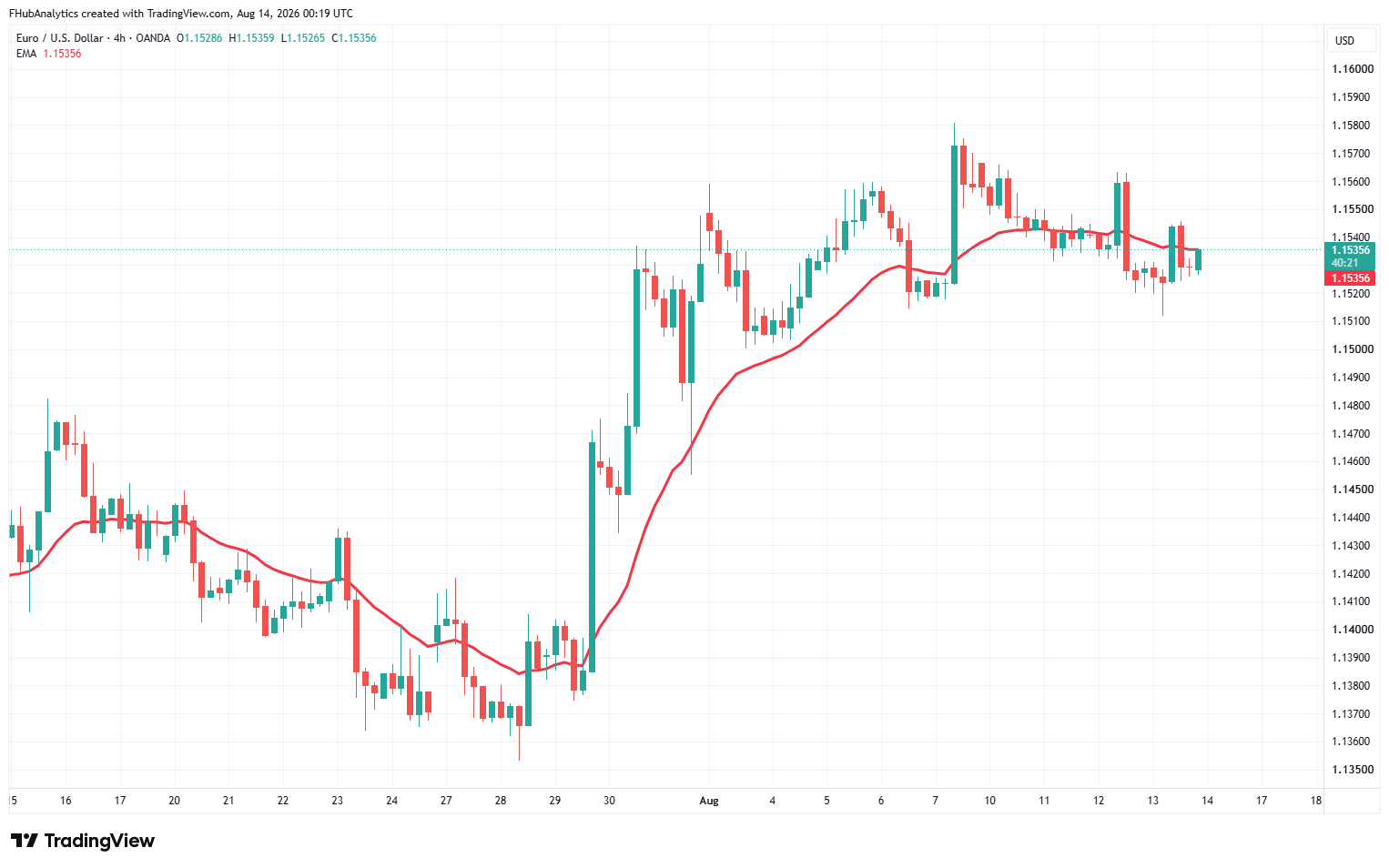
EUR/USD is holding steady above the 1.1500 level after a two-week stretch of relatively calm trading, with the pair last changing hands around 1.1529. The move comes as softer US inflation data trims expectations for another Federal Reserve rate hike, even as safe-haven demand for the Dollar and a hawkish-leaning European Central Bank (ECB) keep the pair from breaking cleanly in either direction.
Foreign exchange analysts at Rabobank have nudged their one-month EUR/USD forecast up to 1.15 from 1.14, but they're not calling for a breakout. Instead, the bank expects "choppy range trading" to dominate through the rest of 2026, with the pair likely stuck between 1.15 and 1.16 on a three-to-six-month view.
Why the Dollar's usual playbook isn't quite working
Normally, oil prices and the US Dollar move in opposite directions. Rabobank says that relationship "appeared to break down in June," a shift it links to a run-up in market speculation around Fed rate hikes. Since then, interest-rate expectations have taken over as the bigger driver of Dollar moves — and those expectations have been softening.
July's US Consumer Price Index (CPI) matched forecasts, and the Producer Price Index (PPI) that followed a day later confirmed the same disinflation trend, cooling to 4.7% on the headline reading and 4.2% on the core figure compared with June. That combination pushed traders to pare back bets on a Fed hike in September, with the odds of a hike by year-end slipping to around 67%, down from roughly 70% the day before. A softer jobs report released earlier in the week added to the case, easing concerns about inflation feeding on itself through wage pressure. Jobless claims, meanwhile, ticked up to 209,000 from 200,000, slightly above the four-week average of 199,000.
The Strait of Hormuz is still doing the heavy lifting for the Dollar
Even with rate-hike bets fading, Rabobank isn't turning outright bearish on the Dollar. Iran has reaffirmed that the Strait of Hormuz — a critical shipping route for global oil — remains closed, a claim echoed by US President Donald Trump. As long as shipping stays curtailed, Rabobank expects the Dollar to keep a safe-haven premium, backed by the US's status as a major energy exporter. The Eurozone, by contrast, is seen as more exposed to the growth and inflation fallout of expensive energy.
Adding to the picture, inflation in Spain jumped to 3.9% — its highest level since May 2025 — driven by rising energy costs. That's pushed money markets to price in a near 87% probability that the ECB will hike rates by a quarter point at its September meeting, giving the Euro side of the pair its own source of support.
What the charts are showing
On the daily chart, EUR/USD is holding a mildly bullish near-term bias. A cluster of moving averages near 1.1465 is acting as a supportive floor, while a former resistance trendline — broken at 1.1477 — has flipped into support underneath current price. The 14-period Relative Strength Index sits around 57, pointing to steady buying interest without flashing overbought signals. The next major hurdle on the topside is horizontal resistance at 1.1849, a break of which could open the door to a broader bullish extension.
Zooming out, the pair's current calm follows a bullish breakout after the Fed's rate decision two weeks ago. That breakout traced a falling wedge pattern that resolved higher, pushing EUR/USD up to resistance near 1.1469 before a fresh leg of Dollar weakness — tied to a sell-off in the crowded USD/JPY trade — helped lift the pair above 1.1500, where it has largely stayed since.
What this means for EUR/USD
With Fed and ECB expectations both leaning in the Euro's favor, but geopolitical risk still propping up the Dollar, EUR/USD looks set to keep chopping inside its recent range rather than trend decisively. Rabobank frames the 1.15–1.16 zone less as a target and more as the current battleground between these two competing forces — softer Fed hike odds pulling the Dollar down, and energy-driven safe-haven demand holding it up.
What traders should prepare for
Range-bound conditions between roughly 1.1465 and 1.1849, with 1.1500 acting as a key pivot
Friday's Eurozone GDP release (forecast at 0.4% QoQ, 1% YoY) and US Retail Sales (forecast at 0.1% MoM) as the next potential catalysts
Continued sensitivity to Strait of Hormuz headlines, which can quickly boost Dollar safe-haven demand
Watching the September 16 Fed meeting and ECB's September decision, where hike/hold odds are actively shifting
A close above 1.1849 or a break below the 1.1465 SMA cluster as signals that could end the current range phase
Bottom line: EUR/USD is caught between a softening Fed and a hawkish ECB on one side, and Dollar safe-haven demand from the Strait of Hormuz on the other — a tug-of-war that favors range trading over a clean breakout for now.